If you’ve ever walked through a commercial building’s basement, a data center’s server farm, or a busy industrial factory floor, you’ve probably seen wire mesh cable tray stretched along walls and ceilings, holding a tangled mass of Ethernet cables, power lines, and fiber optic cables in neat, organized rows. As a wire mesh cable tray supplier, I get asked about this all the time: “What’s the minimum bend radius of wire mesh cable tray, and why does it even matter?” A lot of installers and even some project managers I work with treat bend radii as a generic rule of thumb—like “bend it around the pipe, it’ll be fine”—but over the years, I’ve seen mistakes here turn into costly delays, damaged cables, and even safety hazards that could have been avoided with a basic understanding of how wire mesh cable tray works when you bend it. Wire Mesh Cable Tray
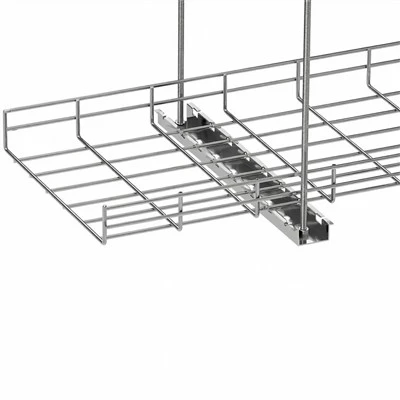
Let’s start with the basics for anyone who might be new to wire mesh cable tray. Unlike solid metal cable trays that are just a flat trough with sides, wire mesh cable tray is made from interwoven steel wires (usually galvanized steel, sometimes stainless steel for harsh environments) that form a rigid, open grid. This design is why it’s so popular: it’s lightweight, lets air circulate around cables to prevent overheating, and makes it easy to add or remove cables without unscrewing panels. But that same open, mesh structure is what makes its bend radius different from other types of cable tray, and why getting the minimum measurement right is non-negotiable.
First, let’s define what minimum bend radius actually means for cable tray, not just the cables that run inside it. A lot of people confuse the two, and that’s where a lot of misinformation starts. The minimum bend radius (MBR) of cable tray is the tightest curve you can form along the tray’s length without causing permanent deformation to the tray itself, or compromising its ability to support cables. For the cables inside, their own MBR is a separate number set by the cable manufacturer—for example, Ethernet cables might have an MBR of 4 times their diameter, while fiber optic cables can be as high as 10 times their diameter. But today, we’re talking about the tray’s MBR, because that’s the number we specify when engineering a system.
Now, what is that actual number, and why does it vary? The short answer is: it’s not a one-size-fits-all number. Most standard commercial wire mesh cable tray (the kind we supply for general office buildings, retail spaces, and light industrial use) has a minimum bend radius of 12 inches, or 305 millimeters, for trays that are 6 inches wide or narrower. For wider trays—say 8 inches or 12 inches wide—the minimum goes up to 18 inches (457 millimeters), and for 24-inch wide tray, it’s around 30 inches (762 millimeters). But wait, that’s just the industry standard for our stock products. There are a dozen factors that can change that number for your specific project.
Let’s break down those factors, because this is where our team as a supplier adds value—we don’t just send you a tray and say “follow the rule,” we walk you through adjusting that number based on your needs. First, material grade. The standard wire mesh tray we make is hot-dip galvanized steel, which has good flexibility for bending but is rigid enough for heavy loads. If you go with 304 stainless steel for a food processing plant or coastal facility where corrosion is a risk, that material is slightly stiffer than standard galvanized, so its minimum bend radius is about 10% higher—so 13.5 inches for a 6-inch wide tray, not 12. Thinner gauge wire (used for light-load applications like residential wiring or small office networks) has a lower MBR, sometimes as low as 8 inches for 6-inch wide tray, while heavy-gauge wire for supporting high-voltage power lines will have a higher MBR, closer to 15 inches for the same width.
Next, load weight. This is a big one that’s often overlooked. If you’re bending a tray that’s only holding 10 light Ethernet cables, you can go tighter than if you’re bending a tray loaded with 50 power cables totaling 500 pounds. When you bend a tray around a tight radius, the outside of the curve stretches, and the inside compresses. If the tray is under a heavy load, that compression or stretching puts extra stress on the mesh wires, which can cause them to pull apart or even snap over time. We always advise our customers that if their tray will be carrying more than 50 pounds per linear foot, they should add 20% to the standard MBR for their tray width. I remember a project a few years back at a manufacturing plant where the installer tried to bend a 12-inch wide tray with a standard 18-inch MBR, but they loaded it with 70 pounds per foot of power cables. Within 6 months, the tray had a small crack along the outer curve, and they had to replace 20 feet of tray at a cost of thousands of dollars, plus downtime for their production line. That’s the kind of avoidable mistake that makes us emphasize load-based adjustments.
Another factor: bend angle. A 90-degree bend will have a different MBR than a 45-degree bend, even for the same tray width and material. When you bend a tray sharply, the stress accumulates along the bend point. For a 90-degree turn around a pillar, for example, you’ll need a larger radius than if you’re just shifting the tray 30 degrees along a straight run. We always recommend adding an extra 10% to the MBR if you’re making a bend steeper than 60 degrees, just to reduce stress at the curve.
Environment also plays a role. If the tray is going outside, exposed to freezing temperatures, or in a high-vibration area like a factory floor near heavy machinery, the metal becomes more brittle. Cold weather makes steel less flexible, so bending at a tight radius in winter can cause the mesh to crack. Vibration adds cyclic stress over time, so a tray that’s bent at the minimum MBR in a high-vibration area can develop fatigue cracks within a year or two, instead of the 20+ year lifespan wire mesh tray is designed for. For outdoor or high-vibration applications, we always suggest a MBR that’s 25% higher than the standard for that tray width.
Wait, but what about custom bends? A lot of installers ask if they can make their own curved tray sections on site, instead of using pre-bent elbows. That’s possible, but it’s where most people go wrong. Pre-bent elbows from our supplier are engineered with the exact minimum MBR for the tray, so they distribute stress evenly along the curve. If you try to bend a straight section on site with a pipe bender or a hammer, you’ll almost always end up with a tighter, uneven bend that concentrates stress in one spot. I’ve seen installers save $50 by bending their own elbows, only to have to replace $2,000 worth of tray a year later. The right move is to use pre-fabricated curved sections that meet the MBR requirements, or if you need a custom radius we don’t stock, we can engineer a custom section for you, tested to hold the required load without deformation.
Now, let’s talk about why this actually matters for your project, beyond just avoiding tray damage. The whole point of using wire mesh cable tray is to organize cables, make them easy to access, and keep them safe. If the tray is bent at too tight a radius, the cables inside can also be damaged. Even if you hit the cable’s MBR, a tight tray bend can put extra pressure on cable jackets, leading to insulation breakdown over time, which causes signal loss or electrical shorts. For data centers, where fiber optic cables carry critical data, that signal loss can translate to downtime that costs businesses thousands of dollars per minute. For industrial facilities, electrical shorts can lead to fires or equipment damage. So the tray’s MBR isn’t just a technical specification—it’s part of keeping your entire electrical or data system reliable.
I should also clarify a common misconception: some installers think that if the cables can fit around a tight bend, the tray is fine. That’s backwards. The tray’s MBR has to be larger than the cable’s MBR, because the tray has to create enough space for the cables to bend without crowding, and the tray itself has to maintain its shape. If you have a tray that’s only just large enough for the cables to fit through a tight bend, you’re asking for problems down the line. We always recommend leaving at least 2 inches of extra space between the cables and the inner edge of the tray at any bend, to prevent that crowding.
Let’s use a real example to make this concrete. Suppose you’re working on a 5,000 square foot office building, with 6-inch wide galvanized wire mesh tray, carrying 10 Cat 6 Ethernet cables and 2 12-gauge power cables. That’s a light load, around 10 pounds per linear foot. The standard MBR for a 6-inch tray is 12 inches. You’re making a 90-degree turn around a 10-inch diameter pillar. Here, you can use the standard 12-inch MBR, right? Well, check the bend angle: it’s 90 degrees, so add 10%, making it 13.2 inches. That’s just a little larger than the 10-inch pillar, so you’d either use a pre-bent 14-inch radius elbow or adjust the pillar location slightly if possible. If you tried to bend the tray around the 10-inch pillar without adjusting, you’d have a tight bend, which over time would cause the wires in the tray to stretch and the cable jackets to wear.
Another example: a factory floor with 12-inch wide 304 stainless steel tray, carrying 40 10-gauge power cables, totaling 60 pounds per linear foot, in an area with constant vibration from assembly lines. The standard MBR for a 12-inch stainless steel tray is 19.8 inches (18 inches plus 10% for the material). But since the load is over 50 pounds per foot, add 20% to that MBR, making it around 23.8 inches. Then add 25% for high vibration, bringing it to almost 30 inches. So you’d need a pre-bent elbow with a 30-inch radius for that turn, to keep everything safe and long-lasting.
Now, what if you’re working with a smaller or larger tray? For 2-inch wide tray, commonly used for running small Ethernet cables behind walls, the MBR is as low as 4 inches, even for light loads. For 36-inch wide heavy-duty tray used in large data centers, the MBR goes up to 48 inches, because the wider tray has more material to support, so bending it tighter would cause too much stress on the mesh.
As a wire mesh cable tray supplier, we’ve seen every mistake in the book when it comes to minimum bend radius. We’ve helped installers troubleshoot projects where a tight bend caused a tray to crack within weeks, we’ve worked with architects to design systems that meet all code requirements without wasting excess material on oversized bends, and we’ve supplied custom engineered tray sections for projects with unique layouts. The key takeaway here is that there’s no universal number—MBR depends on tray width, material, load, bend angle, and environment. It’s not a guess, it’s a calculation that’s specific to your project.

If you’re planning a new installation, or troubleshooting an existing one with bent tray that’s causing issues, we can help. Our team has years of experience working with commercial, industrial, and data center projects, and we don’t just sell tray—we provide guidance on all the technical specs, including minimum bend radius, to make sure your system is safe, reliable, and compliant with local electrical codes. Whether you need standard stock tray, pre-bent elbows, or custom engineered sections for a unique layout, we have the products and expertise to meet your needs. If you have questions about your specific project’s minimum bend radius requirements, or want to discuss ordering, reach out to our team for a consultation.
Wire Mesh Cable Tray References
National Electrical Manufacturers Association (NEMA) Standard VE 2: Wire Mesh Cable Tray, 2021.
Underwriters Laboratories (UL) 204: Standard for Safety for Cable Tray Systems, 2022.
Wire Mesh Manufacturers Association (WMMA) Technical Bulletin 007: Design Considerations for Bend Radius in Wire Mesh Cable Tray, 2020.
National Fire Protection Association (NFPA) 70: National Electrical Code (NEC), Article 390, 2023.
Hebei Shenyi Metal Products Co., Ltd.
Hebei Shenyi Metal Products Co., Ltd. is one of the most professional wire mesh cable tray manufacturers and suppliers in China, featured by quality products and good service. Please rest assured to wholesale durable wire mesh cable tray in stock here and get free sample from our factory. Customized orders are welcome.
Address: Gengtun Industrial Zone, Gengtun Village, Xiliangwa Township, Anping County, Hengshui City, Hebei Province
E-mail: HBshenyi@outlook.com
WebSite: https://www.shenyimetal.com/
